Lepakshi Temple – A Place That Feels Straight Out of a Myth
- anonymous
- Jul 23, 2025
- 5 min read

In the quiet village of Lepakshi, Andhra Pradesh, stands a temple that doesn’t just feel historical — it feels almost otherworldly. This is the Veerabhadra Temple, named after the fierce warrior form of Lord Shiva.
But where does that name come from? Here’s the story behind it — simply put:
Long ago, Lord Shiva was married to Sati, his first wife and great devotee. But her father, Daksha, disapproved of Shiva. He once held a grand ritual (yajna) and deliberately didn’t invite Shiva. Sati still went, hoping things could be made right — but instead, her father insulted Shiva in public.
Heartbroken and deeply hurt, Sati sacrificed herself by jumping into the fire. When Shiva found out, he was devastated. In his grief and rage, he pulled out a strand of his matted hair and threw it to the ground. From it emerged Veerabhadra — a fiery warrior form, created to avenge Sati's death.
That powerful energy — born from loss, love, and divine anger — is what this temple is built around. Even today, many believe that feeling still lives in the stone.
---

A Temple Built on Faith — And a Tragic Turn
The temple was constructed in the 16th century during the Vijayanagara Empire. It was commissioned by two brothers, Viranna and Virupanna, who were officials in the royal court.
Virupanna, deeply devoted to Lord Veerabhadra, began building the temple even before receiving formal approval from the king. When accusations arose that he had used royal funds without permission, he chose not to defend himself.
Instead, as a mark of remorse or surrender to divine justice, he is said to have gouged out his own eyes inside the temple.
To this day, near the incomplete Kalyana Mandapa, there are two reddish stains on a stone wall. Locals believe they mark the exact spot where his eyes fell. These stains have been left untouched, becoming part of the temple’s story.
---
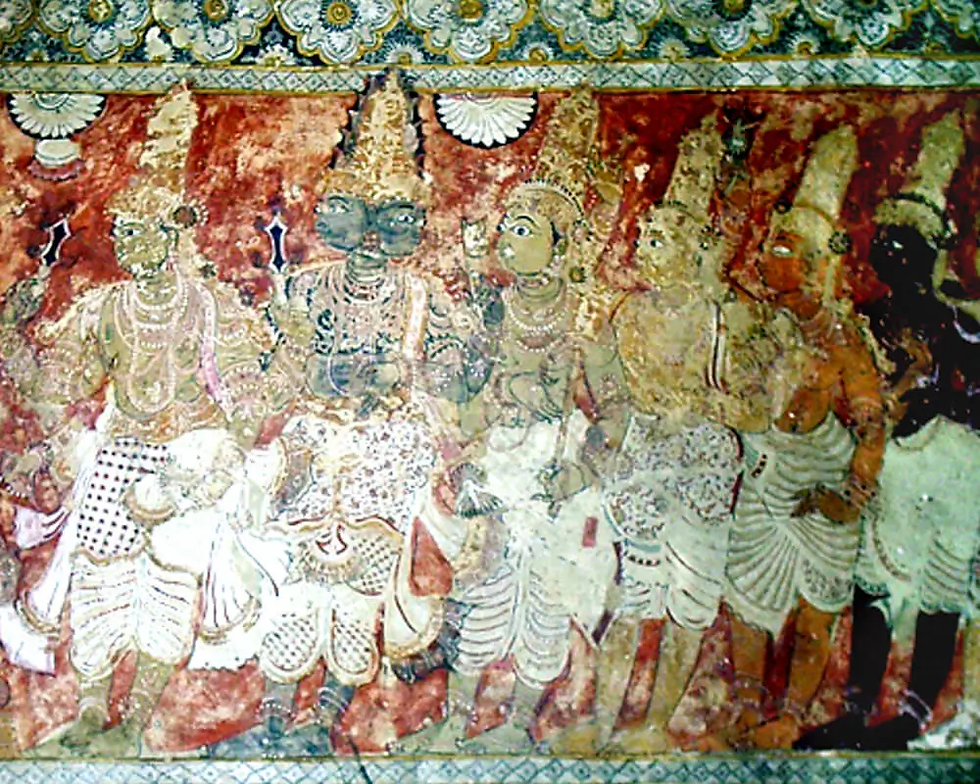
Carvings That Speak
Every corner of the Veerabhadra Temple seems to tell a story.
From the moment one enters the Mukha Mandapa, the space is filled with carvings of gods, dancers, musicians, animals, and mythological scenes. The pillars are not just architectural features — they appear almost alive, capturing movement and emotion.
The ceiling paintings are especially remarkable. One fresco, in particular, depicts the celestial wedding of Shiva and Parvati, with divine figures floating above. It remains one of the largest surviving frescoes from the Vijayanagara era.
At the heart of the temple stands Lord Veerabhadra — not the calm, meditative Shiva many are familiar with, but a fierce form holding weapons, eyes intense and focused. It represents a sacred power born from grief and divine justice.
---

A Serpent and a Lingam — Carved While Waiting for Lunch?
One of the most unique sights at Lepakshi is the large Shiva Lingam sheltered under a coiled seven-headed serpent (Naga). According to local lore, this sculpture was carved by temple workers while they were waiting for their lunch to be served.
It’s said they did it without any formal plan — just skill and devotion. Whether or not that’s true, the result is stunning: a massive piece of art created out of stone and spirit.
---

The Mysterious Hanging Pillar
Among the 70 stone pillars inside the temple, there’s one that has fascinated people for centuries. Known as the hanging pillar, it doesn’t fully touch the ground.
Visitors often slide cloth or paper beneath it — and it goes through. During British rule, an engineer once tried to fix it, assuming it was a flaw. But when he attempted it, the nearby structure began to shift. He immediately stopped, realizing the pillar was part of a careful, ancient balance.
To this day, no one fully understands how it holds the weight above. It remains a small marvel of Indian temple architecture.
---

From the Ramayana: The Bird Who Fell Here
Lepakshi isn’t just linked to Shiva — it also has a strong connection to the Ramayana.
According to legend, this was the place where Jatayu, the divine vulture, fell after trying to rescue Sita from Ravana. Wounded and weak, he waited here until Lord Rama arrived.
When Rama found him, he is said to have cried out, "Le Pakshi!", which means "Rise, O bird" in Telugu. And that’s how the village is believed to have got its name.
There’s also a footprint-shaped mark nearby that never dries, even in heat. Locals say it’s Sita’s footprint. Scientists call it a natural spring — but for many, it’s a sacred trace of that ancient moment.

The Nandi That Aligns Perfectly
A short distance from the temple lies a massive monolithic Nandi — the sacred bull of Shiva. It’s one of the largest of its kind in India, carved from a single block of stone.
What’s even more interesting is how perfectly it lines up with the temple’s main Shiva Lingam. Despite the distance and lack of modern tools, the alignment is said to be exact. It raises the question: Was it sheer skill, or something more spiritual guiding the design?
A Place Full of Stories
The temple is filled with not just carvings and legends — but also the memories of people who came here with devotion.
One story tells of a blind woman who would visit regularly. Even though she couldn’t see, she would touch the walls and describe the scenes in detail. Some say the temple revealed itself to her. Others believe she may have known it in another life.
There are also quiet whispers that some sculptures shift slightly under moonlight. No evidence, just old tales. But in a place like Lepakshi, belief often feels just as real as history.
Built on a Tortoise-Shaped Hill
The temple stands on a hill called Kurma Saila, meaning "Tortoise Hill," as it's shaped like the tortoise avatar of Lord Vishnu. In Indian architecture and Vastu Shastra, this shape is considered very auspicious.
Many believe it brings balance, harmony, and positive energy to the structure. Some even say compasses don’t work properly in certain corners of the temple. Whether or not that’s true, the sense of peace many feel here is real.
A Temple That’s Still Alive
The Veerabhadra Temple isn’t just a historical site — it’s a living place of worship.
Pilgrims still walk barefoot across its stone floors. Locals light lamps near Virupanna’s wall. Artists visit to sketch, writers come to reflect, and many simply sit in silence.
There’s something here — a feeling that the temple still listens.
Have you ever visited the temple and try to pass any object beneath the pillar ????
© 2025 anonymous . All rights reserved
This original work may not be reproduced without permission.


Comments