Purana Qila : A Modern Day Time Machine
- anonymous
- 19 hours ago
- 16 min read
Delhi's Living Time Machine

There is a particular kind of vertigo that strikes you inside Purana Qila not from the height of its 18-metre battlements, but from time itself. Stand at the right angle near the southern gate, and you can see, in a single glance, red sandstone arches from the 1540s, a grassy mound that hides pottery from 1000 BCE, and the glass towers of a modern Indian capital shimmering beyond the walls. Delhi does not erase its pasts. It layers them, presses them into soil and stone, and lets them coexist in a city that is simultaneously ancient and perpetually unfinished.
No site captures this layering more completely than Purana Qila the "Old Fort" that stands near Pragati Maidan on the banks of a Yamuna River that has since shifted a kilometre to the east. The fort that tourists enter today is a 16th-century Mughal and Afghan structure of considerable architectural beauty. But below its visible stone, below the lawns and the moat and the ticketing booth, lies a stratigraphic record that archaeologists have spent the better part of seventy years trying to read a record that may or may not connect this ground to one of the most electrifying questions in South Asian cultural history: Was this Indraprastha?
That question has never been resolved. What has been established painstakingly, layer by layer, potsherd by potsherd is that this site was never truly empty. People lived here. For a very, very long time.
The Epic and the Evidence: What the Mahabharata Actually Says

Before any trowel ever touched this soil in a scientific context, there was a text. The Mahabharata one of the two great Sanskrit epics of ancient India, composed and redacted across many centuries describes the Pandava brothers receiving the forest of Khandavaprastha as their share of the Kuru kingdom. This forested, undeveloped land is then transformed, with divine assistance from the god Indra and the architect-deity Mayasura, into a planned and resplendent city called Indraprastha, meaning "City of Lord Indra."
The epic's description is detailed in ways that historians find significant. The Sabha Parva section speaks of fortified walls, broad avenues, water reservoirs, assembly halls, and the famously illusory palace of Maya the Maya Sabha whose floors were so perfectly tiled they appeared to be pools of water and vice versa. This is not the description of a village or a camp. It is the literary image of an urban capital, a seat of political authority with planned infrastructure and monumental buildings.
However, as historian Romila Thapar has consistently pointed out, epics are not maps. They are literary traditions that encode social memory, moral philosophy, and early historical experience but they are not precise geographical records. The Mahabharata was composed, transmitted orally, redacted, and finally written down across an enormous span of time. What it preserves is a memory of early urbanism and state formation in the Ganga-Yamuna doab not a street address.
The historian's task, therefore, is not to use the Mahabharata as a guide to excavation, but to ask independently: does the archaeological record at Purana Qila show occupation from the early Iron Age period that roughly corresponds to the time frame traditionally associated with the Mahabharata narrative? That question properly empirical is what has driven nearly seven rounds of excavation.
Who Started the Indraprastha Debate?
The identification of Purana Qila with Indraprastha is not a modern nationalist enthusiasm it has deep historical roots, predating any scientific archaeology by centuries.
Abul Fazl and the Ain-i-Akbari (16th Century)

The earliest textual documentation comes from Abul Fazl, the court historian of Emperor Akbar. In the Ain-i-Akbari, Abul Fazl explicitly states that Humayun built his city Dinpanah at the site of the ancient Indraprastha, the capital of the Pandavas. This appears as a matter of settled local knowledge suggesting that by the 16th century, the oral and cultural memory connecting this site to the Pandavas was already well established in the region. The Mughal chronicler Muhammad Khwandamir also recorded that Humayun laid the foundation of his city on a mound near the Yamuna a detail consistent with the archaeological tell that excavations would later confirm.
The Village of Indrapat

Perhaps the most striking evidence of long-standing popular identification is the existence of a village named Indrapat a corruption of Indraprastha actually inside the walls of Purana Qila until 1913. When Edwin Lutyens's team began planning New Delhi as the new imperial capital, this village was relocated. Its persistence for centuries within the fort compound, carrying the name of the ancient capital, tells us that the local tradition of association was never broken.
Alexander Cunningham and the Colonial Archaeological Survey

Alexander Cunningham, the 19th-century archaeologist who founded the Archaeological Survey of India, formally identified Purana Qila with the site of Indraprastha in his surveys. His identification was significant because it moved the association from popular legend into the domain of official scholarship — even as he acknowledged that the visible standing structure was entirely medieval.
B.B. Lal and the Scientific Era

It was not until B.B. Lal conducted the first stratigraphic excavations in 1954–55 that the debate shifted from textual argument to material evidence. Lal was the first to subject the Indraprastha question to an empirical test — which is why he is rightly regarded as the founding figure of the modern scientific debate around Purana Qila's ancient history.
The Mound Itself

To understand why Purana Qila we need to understand what it physically is. The fort does not simply sit on flat ground. It sits on a tell an artificial mound created by continuous human occupation over millennia.
Every generation of inhabitants produces waste: broken pottery, ash, collapsed mudbrick, discarded tools, animal bones. This waste accumulates. The ground level rises. Each new community builds on the debris of the previous one. Over centuries, this process creates elevated mounds that are, layer by layer, chronological archives of human settlement the same phenomenon that creates the great archaeological tells of Mesopotamia and the ancient mounds of the Indus Valley.
According to the Heritage Journal of Multidisciplinary Studies in Archaeology (2023–24), the mound at Purana Qila measures approximately 710 metres from north to south and 350 metres east to west, with a perimeter of 2 kilometres and an average minimum height of 11 metres above the surrounding landscape. The maximum depth of habitational deposits reached in recent excavations approaches 14 metres. Through cylindrical boring, archaeologists have established that cultural deposits continue to approximately 16–17 metres depth meaning the natural soil, the geological base level below which no human occupation exists, has still not been reached.
This last point is crucial. Even after reaching 14 metres, history here may go deeper still.
B.B. Lal and the First Scientific Excavations (1954–1973)
Braj Basi Lal, later awarded the Padma Vibhushan, was Director General of the Archaeological Survey of India when he conducted excavations at Purana Qila in 1954–55 and again from 1969 to 1973. These were part of a larger systematic project in which Lal excavated multiple sites mentioned in the Mahabharata across northern India Hastinapur, Mathura, Ahichatra, Kampilya, Barnava, and Kurukshetra.
At every single one of these sites, he found a consistent ceramic marker: Painted Grey Ware. He also found at Hastinapur a major flood deposit, which he connected to the Mahabharata's own mention of Hastinapur being abandoned due to flooding of the Ganga. When Lal found PGW at Purana Qila as well in the lowest cultural levels reached he cautiously suggested that the site had been settled during the time period associated with the Mahabharata. He stopped short of declaring it definitively as Indraprastha, but the association took firm root in scholarly discourse.
However, Lal's critics noted an important limitation: the PGW sherds at Purana Qila were not in a clean, isolated, undisturbed stratigraphic layer. They appeared in mixed or transitional contexts. This opened the door for sceptical interpretations that would drive excavations for decades to come.
![Painted Grey ware [PGW]](https://static.wixstatic.com/media/00b32d_36b3ee21547d4fbbac8ad5ad63c469d1~mv2.png/v1/fill/w_400,h_546,al_c,q_85,enc_avif,quality_auto/00b32d_36b3ee21547d4fbbac8ad5ad63c469d1~mv2.png)
Painted Grey Ware (PGW) is a distinctive style of fine, wheel-made pottery grey in colour, often with geometric designs painted in black. It is associated with early Iron Age settlements in the Ganga-Yamuna region and is dated broadly to between 1200 BCE and 600 BCE. It is found in association with iron artefacts, reflecting the transition from the Chalcolithic to the early Iron Age in north India.
B.B. Lal's excavations at Hastinapur established PGW as the ceramic horizon of sites associated with the Kuru-Panchala cultural complex the tribal confederacies and early kingdoms described in the Mahabharata. When the same pottery appears at the lowest levels of Purana Qila, it suggests the site was occupied during the same broad cultural phase.
However and this is a caveat that sceptical historians repeatedly emphasise PGW is not exclusively a Mahabharata marker. It has been found at many sites in northern India that have no Mahabharata associations whatsoever, including Salimgarh, Majnu-ka-Tila, and numerous other locations in and around Delhi itself. The presence of PGW proves early Iron Age habitation. It does not prove that the specific community living here was the one described in the epic.
As ASI archaeologist Vasant Kumar Swarnkar has noted: "Each era in history is identified by its pottery along with associated ware or structural forms." The pottery places you in time. It does not write your name.
Layer by Layer: The Nine Cultural Periods at Purana Qila
What makes Purana Qila exceptional is not any single discovery but the completeness of its stratigraphic sequence. ASI excavations have identified nine distinct cultural periods at the site, with no significant breaks in human occupation between them. This is an archaeologist's dream a continuous cultural column from the pre-Mauryan era to the Mughal period without interruption.
Period I — Pre-Mauryan / Painted Grey Ware Phase (c. 1200–600 BCE)
The earliest identified cultural level. PGW sherds, iron objects, and evidence of early habitation. Organic samples tested at Beta Analytic Lab, Florida, have returned dates as early as 540 BCE. Below this level, evidence of probable water submergence possibly a flood deposit has been identified, and soil samples have been sent to laboratories to understand the extent of the ancient Yamuna. Natural soil has not yet been reached.
Period II — Mauryan and Shunga Period (c. 4th–2nd Century BCE)

Northern Black Polished Ware (NBPW), kiln-burnt bricks, and a major discovery from the 2023 excavation: structural remains of a 2,500-year-old terracotta ring well from the Mauryan period. Ring wells — circular structures of stacked clay rings inserted into the ground — are diagnostic of organised urban settlement, commonly found at early historic cities like Kaushambi and Mathura. The Shunga phase shows mud-brick structures and rubble stone constructions, with burnt patches suggesting possible episodes of destruction or industrial activity. A well-defined four-room structural complex dating back approximately 2,300 years from the Shunga-Kushan transitional period was also uncovered.
Period III — Kushan Period (c. 1st–3rd Century CE)
Identified through red ware pottery, moulded terracotta figurines, and coins. The 2023 excavations, reaching a depth of 5.5 metres, exposed structures from the early Kushan level. Coins are particularly reliable dating tools; numismatic evidence from this layer places it securely within the Kushan commercial network that stretched from Central Asia to the Gangetic plain.
Period IV — Gupta Period (c. 4th–6th Century CE)

Gupta-style bricks, seals, and terracotta objects. A terracotta plaque of Goddess Gaja Lakshmi from the Gupta period was among the significant finds from recent excavations an object of ritual and artistic importance indicating a flourishing cultural life at the site during what historians call India's classical age.
Period V — Post-Gupta and Rajput Period (c. 7th–11th Century CE)

One of the most striking finds from recent excavation rounds: a 900-year-old stone image of Vaikuntha Vishnu, belonging to the Rajput period. Also recovered were seals and sealings, along with evidence of industrial activity and cultivation evidence not found during B.B. Lal's earlier excavations, suggesting new data from previously unexcavated sections of the mound.
Period VI — Delhi Sultanate Period (c. 12th–15th Century CE)
Pottery, structural remains, and artefacts from the successive Sultanate dynasties. The site continued to be occupied through the Mamluk, Khalji, Tughlaq, Sayyid, and Lodi phases, reflecting Delhi's continuous political importance across three centuries of Islamic rule before the Mughals arrived.
Period VII — Mughal Period: Dinpanah and Purana Qila (1533 CE onwards)
The visible monument. Humayun's Dinpanah and Sher Shah's Shergarh. The uppermost cultural layer is the most visible the massive rubble-masonry walls, gateways, mosque, and octagonal pavilion that define the site for every visitor today.
Modern Excavations: Vasant Swarnkar and the Renewed Quest (2013–2024)
After Lal's pioneering work, Purana Qila was largely left undisturbed for decades. The modern chapter of excavation began when Dr. Vasant Kumar Swarnkar of the ASI led renewed digging in 2013–14 and again in 2017–18 and 2022–23, making him the principal archaeologist shaping our current understanding of the site.
The 2013–14 Excavation

PGW sherds were found in a pre-Mauryan stratum but the layer in which they appeared was identified as a flood deposit, a silt layer left by ancient Yamuna flooding. Swarnkar himself acknowledged the limitation: finding PGW in a flood layer means the sherds could have been carried from their original settlement context by water action. Tantalising but not conclusive.
The 2017–18 Excavation

The team went deeper than Lal ever had, but still did not find PGW in a clean, undisturbed stratified context. Swarnkar was candid: "Though we have found sherds of PGW in various layers, we haven't found them in a stratified layer yet. It's possible that we have dug up a wrong patch. Discovery of sherds means there must be a PGW settlement nearby, but not at the patch where we have dug. We have to find the exact spot. It could be just a hundred metres away." (Swarajya Magazine, 2018)
The 2022–23 Excavation: The Richest Season Yet

Initiated in January 2023, this proved to be the most artefact-rich season in the site's excavation history. From a small area near the Sher Mandal, the team recovered: a stone image of Vaikuntha Vishnu, a terracotta plaque of Gaja Lakshmi, a stone image of Ganesha, more than 136 coins, 35 seals and sealings, terracotta figurines of humans and animals, beads of various stones, and a bone needle. Structural evidence included a Mauryan-era terracotta ring well and a Shunga-Kushan four-room complex. Union Tourism and Culture Minister G. Kishan Reddy, who inspected the ongoing dig, noted that the density of coins and seals indicated Purana Qila served as a significant centre for trade across multiple historical periods.
Cylindrical boring also established that habitational deposits continue to depths of 16–17 metres well beyond the maximum currently excavated depth of 14 metres. Natural soil remains out of reach.
The Great Debate: What Scholars Actually Say
Arguments Supporting the Indraprastha Association
PGW — the same ceramic culture found at Hastinapur, Mathura, and other Mahabharata sites is present at Purana Qila at the earliest excavated levels (B.B. Lal, multiple ASI reports)
The site sits on a major archaeological tell showing unbroken occupation for nearly 3,000 years exactly what a historically significant capital would produce
Abul Fazl's Ain-i-Akbari (16th century) records the Indraprastha association as established local knowledge, not speculation
The village of Indrapat survived inside the fort walls until 1913, preserving the name of Indraprastha in continuous living tradition
Organic samples tested at Beta Analytic Lab, Florida, have returned dates as early as 540 BCE from PGW-associated layers (Heritage Journal of Multidisciplinary Studies in Archaeology, 2023–24)
Evidence of water submergence below the PGW layer mirrors the flood evidence at Hastinapur that Lal associated with the Mahabharata narrative
Vasant Swarnkar: PGW findings allow Delhi's history to be traced to 1200 BCE, indicating continuous habitation from that period
Scholarly Cautions and Counter-Arguments
PGW has been found at many sites in and around Delhi (Salimgarh, Majnu-ka-Tila, etc.) with no Mahabharata association its presence alone proves nothing (ASI Director General Y.S. Rawat)
— No PGW has yet been found in a clean, undisturbed, stratified layer at Purana Qila; sherds appear in mixed or flood contexts (Swarnkar himself, 2018)
— Historian Upinder Singh urges caution: PGW indicates habitation from c. 1000 BCE but does not establish a direct link to the Mahabharata
— R.S. Bisht (retired Joint DG, ASI): older cultural levels than PGW have been found at some sites B.B. Lal excavated, complicating the equation
— The Mahabharata was composed and redacted over centuries; its geographical descriptions reflect literary memory, not precise topography (Romila Thapar)
— Natural soil has not yet been reached; the full depth of human occupation at this site remains unknown
What is notable is that even the most cautious voices do not deny the extraordinary antiquity of the site. The debate is specifically about whether the PGW evidence establishes a link to the Mahabharata's Indraprastha — not whether people lived here in the early Iron Age. That they did is now beyond serious dispute.
The Fort You Can See: Architecture of Humayun and Sher Shah

The visible Purana Qila is one of north India's most important monuments of the 16th century a remarkable work of architectural transition standing at the precise moment when the Lodi aesthetic was giving way to Mughal grandeur.
In 1533, three years after ascending the throne of Delhi, the Mughal emperor Humayun laid the foundation of what he called Dinpanah "Refuge of Faith." Muhammad Khwandamir recorded that Humayun laid the foundation on a mound near the Yamuna, and that by his time, the walls and fortifications were nearly complete. In 1540, Sher Shah Suri defeated and displaced Humayun, took control of the fort, renamed it Shergarh, and built the major surviving interior structures. Historical sources remain divided on the precise attribution of specific buildings historian MC Joshi argues that Sher Shah completed a mosque that Humayun had originally designed and begun.
The Fortification Walls and Three Gateways

The walls of Purana Qila rise to 18 metres, traverse approximately 1.5 kilometres, and are punctuated by three monumental gateways. The Bara Darwaza (Big Gate) faces west and remains the primary entrance today. The Humayun Gate on the south is a two-storeyed sandstone structure. The Talaqi Darwaza the "Forbidden Gate" on the north is steeped in folklore; one tradition holds it was sealed by a queen after her husband fell in battle. All three gateways are double-storeyed sandstone structures flanked by massive semi-circular bastion towers, decorated with white and coloured marble inlays and blue tiles, and topped by pillared chhatris features that anticipate the mature Mughal style of Akbar and Shah Jahan.
Qila-i-Kuhna Mosque (1541 CE)

The best-preserved building within the fort and one of the most architecturally significant pre-Mughal mosques in India. Built by Sher Shah Suri, this single-domed congregational mosque has a prayer hall measuring 51.2 metres by 14.9 metres, with five elegant pointed arches featuring true horseshoe-shaped designs an early and innovative use in the subcontinent. The mosque deploys red and yellow sandstone with calligraphic marble inscriptions on the central iwan, marking the transitional moment between Lodi and Mughal aesthetics. A marble inscription within reads: "As long as there are people on the earth, may this edifice be frequented and people be happy and cheerful in it."
Sher Mandal
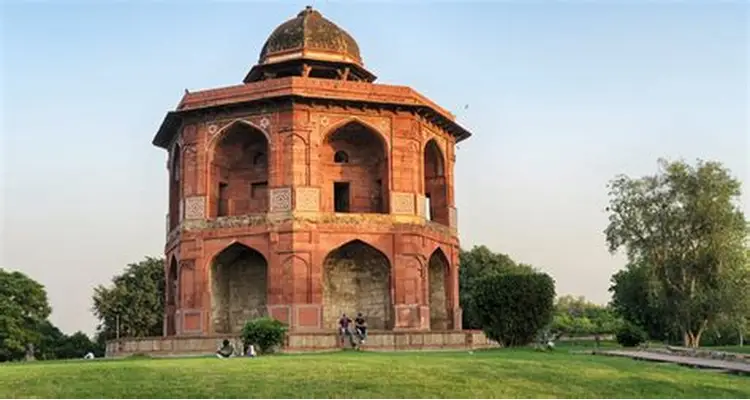
This compact double-storeyed octagonal tower of red sandstone is the only surviving palace structure within the fort. Originally attributed to Babur, it was completed and used by Humayun as a personal library and observatory reflecting his well-documented interest in astrology and astronomy. Abul Fazl recorded that on 20 January 1556, Humayun was descending the stairs of this structure after blessing his subjects from the roof when he heard the azaan. He knelt on the steps, rose, caught his foot in his robe, and fell headlong. He died of his injuries two days later making the Sher Mandal the site of one of the most historically significant accidents in Indian history.
The Baoli (Stepwell)

A 22-metre-deep stepwell located to the north-east of Sher Mandal, which served the fort's residents across generations. It survives as a reminder that the "medieval" monuments of Purana Qila were not merely ceremonial they were functioning urban infrastructure.
The Hammam (Royal Bath)

The remains of a hammam a royal bathhouse with provision for hot and cold water and steam survive to the west of Sher Mandal. Remains of a water chute and terracotta pipes are visible in the underground chamber, reflecting the same tradition of hydraulic sophistication that would reach its most refined expression in Shah Jahan's Red Fort.
The Modern Layers
Purana Qila's role as a site of accumulated history did not end with the Mughals.
During the Asia-Pacific War (1941–1945), the fort served as a civilian internment camp for Japanese nationals in British India a jarring contrast to its imperial origins.
Perhaps the most emotionally resonant modern chapter came during the Partition of India in August–September 1947. As millions crossed the new borders between India and Pakistan, Purana Qila became a refugee camp for Muslims migrating to the newly created Pakistan. The camp held over 12,000 government employees who had opted for service in Pakistan, and eventually between 150,000 and 200,000 Muslim refugees who flooded into the fort by September 1947. The camp remained functional until early 1948. The fort that had sheltered Mughal emperors thus became, within four centuries, a shelter for displaced families its ancient walls indifferent to the difference between imperial grandeur and humanitarian emergency.
In the 1970s, the ramparts of Purana Qila became one of India's most storied theatrical venues. The National School of Drama staged three landmark productions using the fort walls as backdrop: Tughlaq, Andha Yug, and Sultan Razia, all directed by Ebrahim Alkazi. These productions are remembered as among the defining moments of modern Indian theatre performances set against stone that had witnessed the very history the plays explored.
Purana Qila Today

Purana Qila in 2025–26 is simultaneously a functioning archaeological field site, a major tourist destination, and a monument under intensive new scrutiny.
As of June 2024, the ASI was planning the seventh excavation at the site focusing on new trenches to the west and north of previously explored areas, and particularly around the Kunti Temple area at the centre of the fort. This round is to be preceded by a LIDAR survey a laser scanning technology that creates precise three-dimensional maps of the site, allowing archaeologists to detect buried structures with significantly enhanced accuracy before any physical digging begins.
Artefacts from earlier excavations sickles, terracotta toys, kiln-burnt bricks, beads, terracotta figurines, seals and sealings are currently displayed at the Archaeological Museum inside the Purana Qila Fort Complex. The ASI has announced plans to develop an Open-Air Site Museum at the fort, which would allow visitors to see actual excavation trenches and cultural layers in a controlled, educational setting making Purana Qila one of India's first sites where the archaeological process itself is made visible to the public.
Every evening at sunset, the fort hosts a Sound and Light Show narrating the history of the Seven Cities of Delhi from Indraprastha through New Delhi. The Hindi show runs at 7:30 PM and the English show at 9:00 PM (timings subject to seasonal change).
What the Soil Keeps Saying is Purana Qila Indraprastha?
Archaeology, as practised by the most careful of its practitioners, will not yet say yes. But it says something equally powerful: this ground has never been empty. From at least the early Iron Age from a time when people were making fine grey pots painted with geometric designs and leaving them in the soil of the Yamuna flood plain this location has been home to successive communities who built, traded, worshipped, governed, and died here. Nine identified cultural periods. No interruption. A mound that is 11 metres above its surroundings because 3,000 years of human life is compressed into its earth. Depths of 16–17 metres of habitational deposits, with natural soil still unreached.
When the Mahabharata's poets described Indraprastha a great city on the Yamuna, a centre of political power and urban organisation, a place of strategic and symbolic importance they were not necessarily inventing a geography. They were remembering one. Whether they were remembering this exact ground is what remains open. And it will remain open until the next trowel descends, and the soil gives up another shard, another coin, another layer of the city beneath the city.
That is the honest answer. And in the context of a site this ancient, this continuously inhabited, this stubbornly layered it is a more interesting answer than a simple yes or no could ever be.
Sources: B.B. Lal, ASI Excavation Reports, Purana Qila (1954–55, 1969–73) · Vasant Kumar Swarnkar, Heritage Journal of Multidisciplinary Studies in Archaeology, Vol. 11.1, 2023–24 · B.K. Thapar, "The Buried Past of Delhi," Expedition Magazine, University of Pennsylvania, Vol. 14(2), 1972 · Upinder Singh, Delhi: Ancient History, Social Science Press, 2006 · Abul Fazl, Ain-i-Akbari (16th century) · ASI Press Releases on Purana Qila Excavations, 2023 · Alexander Cunningham, ASI Reports (19th century) · Swarajya Magazine, 2018 · Organiser, June 2024


Comments