Unakoti: The Enigmatic Land of Stone Sculptures
- anonymous
- Jan 5
- 4 min read
Updated: Feb 3
Unakoti, located near the Tripura hills, is a unique landscape filled with gigantic stone sculptures. Its history sends shivers down the spine even today. Unakoti, meaning “one less than a crore”, is believed to contain countless figures of gods, carved as reliefs, standing silently against the passage of time and nature.
These are not small idols meant for enclosed temples. They are massive, open-air carvings spread across forested slopes, as if the land itself was chosen to hold something sacred.
The Legend of Unakoti
Local belief says that Lord Shiva once traveled towards Kashi with a crore gods and goddesses. He asked them to wake up before sunrise, but only Shiva rose on time. Disappointed, he left alone, and the others were cursed to be turned into stone, becoming the countless figures of Unakoti. As one god was missing, the place came to be called Unakoti (one less than a crore).
Another popular story speaks of a devotee sculptor, Kallu Kumhar, who wished to accompany Shiva and Parvati to Mount Kailash. Shiva gave him an almost impossible task: to carve one crore idols in a single night. Kallu worked through the darkness, but when dawn arrived, he had fallen short by one. That failure, according to belief, gave birth to Unakoti.
Every year, a grand fair, popularly known as Ashokastami Mela, is held in April. Thousands of pilgrims visit during this festival. Another smaller festival takes place in January.
Unakoti's Rich History

Archaeologists and historians generally date the sculptures to around the 7th to 9th century CE, prior to the Manikya rule, based on artistic style and iconography. The rock art was patronized by the Deva Dynasty of Sribhumi in Samatata. The only inscription at Unakoti is on the Chaturmukhalinga image, consisting of a couple of records in Bengali characters from the 11th to 12th century CE, which mentions one Sri Jayadeva, probably a pilgrim. This places Unakoti in the early medieval period, when Shaivism was spreading across eastern and northeastern India.
What stands out is the absence of inscriptions. No king claims credit. No dynasty announces patronage. This suggests that Unakoti may not have been a royal project in the strict sense, but rather a religious center shaped by local rulers, ascetics, or communities deeply rooted in Shaivite belief.
British officials first documented the site in the early 20th century, but even then, Unakoti did not fit into known categories of temple architecture. It was not abandoned, yet it was not fully understood. That ambiguity continues even today.
Stone Instead of Temple

Unakoti does not follow the traditional idea of a temple with walls, pillars, and roofs. There is no sanctum, no mandapa, and no constructed enclosure. Instead, the hills themselves were turned into sacred surfaces. Artists carved directly into natural rock faces, allowing the terrain to dictate the form.
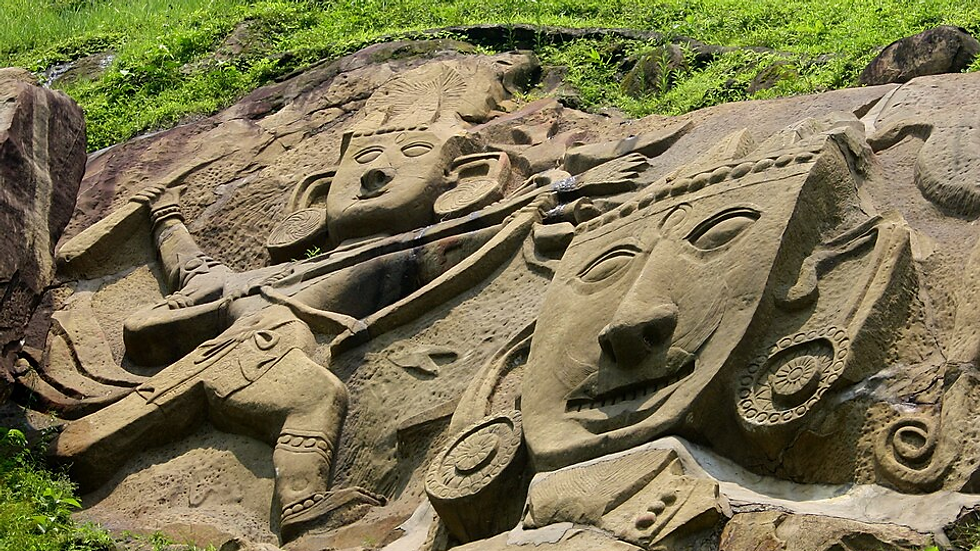
At the heart of the site stands the massive Unakotiswara Kal Bhairava, a huge face of Lord Shiva carved into the hillside, nearly thirty feet tall. The face is calm, powerful, and still. The third eye is visible but not exaggerated. This is not Shiva in action; this is Shiva as presence, watching over the landscape.
Around him are carvings of Parvati, Ganesha, Ganga, Uma-Maheshwara panels, animals, and numerous smaller figures. Many remain unfinished. Chisel marks are still visible. Forms appear to rise from the stone and then stop, as if time itself interrupted the work.

The sculptures show a clear understanding of Shaivite iconography, along with local artistic features. Faces are heavier, expressions restrained, and ornamentation minimal — adapted to the natural shape of the rock. These were likely carved by local artisans and tribal craftsmen, working over long periods, possibly across generations. Instead of bringing stone from elsewhere, they worked with what was already there. The hill was not reshaped to fit the sculpture — the sculpture grew out of the hill.
In this sense, Unakoti proves what human devotion and labor could achieve without modern tools, without written plans, and without the pressure of finishing everything neatly.
The Significance of Unakoti
Unakoti reminds us that history is not always recorded; sometimes it is carved, believed, and remembered. And sometimes, the past survives not in words, but in stone that still stands, still watches, and still refuses to fully explain itself.
As I explore Unakoti, I feel a deep connection to the past. The silence of the stone figures speaks volumes about the devotion that shaped them. Each carving tells a story, a fragment of history that links us to the beliefs and aspirations of those who came before us.
The experience of visiting Unakoti is not just about seeing ancient art; it is about feeling the weight of history. The air is thick with stories, and the landscape itself seems to breathe life into the past.
In conclusion, Unakoti is a testament to the enduring power of faith and creativity. It invites us to reflect on our own beliefs and the ways we express them. The stone sculptures stand as a bridge between the past and the present, reminding us that history is not merely a series of events but a living narrative that continues to shape our world today.
All rights are reserved.


Comments