From Scrolls to Source Code: A Time Travel Into the Hacking World
- anonymous
- Jul 16, 2025
- 6 min read
Updated: Jul 20, 2025
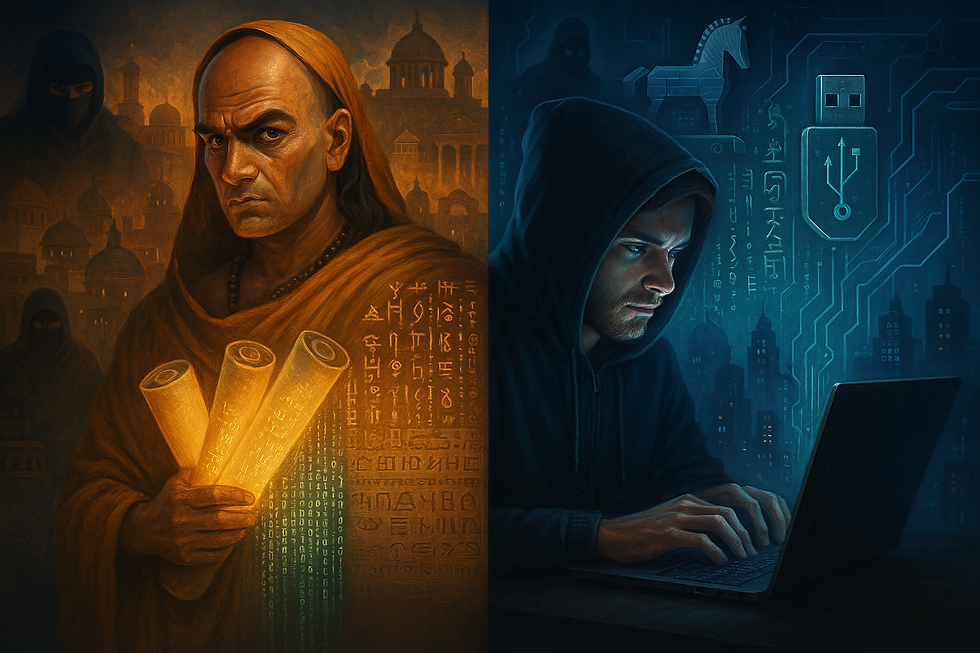
When you hear the word “hacker,” you probably picture someone in a hoodie, typing lines of code to break into a digital system. But what if I told you that hacking started thousands of years ago, not with laptops or Wi-Fi — but with scrolls, sandals, and spies?
Long before the internet, ancient civilizations were already doing what modern hackers do: gathering information, deceiving enemies, and protecting secrets. They just did it differently — not through malware or brute-force attacks, but through clever disguises, mind games, and manipulation.
Let’s journey back in time and uncover how empires like India, Rome, Greece, China, and others used spycraft as their version of ethical hacking — and what we can learn from them today.
Chanakya: India’s Master of Strategic Deception
Let’s start in ancient India, around the 4th century BCE. Here lived Chanakya, also known as Kautilya — a brilliant strategist, economist, and the chief advisor to Chandragupta Maurya, the founder of the Mauryan Empire.
Chanakya wrote a book called the Arthashastra, which might sound like a dry political manual, but it’s actually a masterclass in espionage. If you read between the lines, it’s less like a philosophy book and more like an ancient playbook on intelligence — a kind of proto-cybersecurity guide.
Ancient Spy Role | Modern Equivalent | Function |
Dvidha-chara (Double agent) | Red team hacker | Infiltrate systems and reveal weaknesses |
Sansthanika (Internal spy) | Insider threat analyst | Monitor internal leaks |
Vyanjana (Coded messenger) | Encryption specialist | Deliver secret info using hidden meanings |
Tapo-dharma-chara (Ascetic spy) | Social engineer | Gain trust via manipulated identity |
Uddeshika (Targeted informant) | OSINT investigator | Gather public sentiment & chatter |
Inside Chanakya’s Spy Network
Double agents (Dvidha-charas) were deployed across enemy states disguised as monks, merchants, actors, or artists. Their goal? Mislead the enemy, collect intel, and shift public opinion.
Women spies weren’t just part of the system — they were essential. Courtesans (veshya), household women (grihpatika), and female ascetics (bhikshuni) were trained to enter elite social circles and gather sensitive information without raising suspicion.
Staged events, like fake public celebrations or religious processions, were used to spread false narratives or provoke enemy missteps.
Agents were often placed in temples, markets, and guilds to observe citizens, detect rebellion, and influence local leaders.
Chanakya understood something cybersecurity experts still stress today: people are the weakest link. His spies didn’t hack systems — they hacked minds.
“Infiltrate their thoughts, not just their borders.” — Chanakya (paraphrased)
Sound familiar? Social engineering — where hackers manipulate people into revealing information — is one of the most common hacking methods today. Chanakya was just 2,300 years early.
Rome: Surveillance in the Shadows of the Empire
When it comes to organization and efficiency, the Roman Empire stands tall. But beyond the aqueducts and roads, Rome also built one of the earliest institutionalized surveillance systems.
They didn’t call it cybersecurity — they called it survival.
Rome’s Spy Forces
Speculatores were elite scouts and intelligence gatherers. They worked within the Roman military, infiltrated enemy ranks, monitored loyalty among soldiers, and reported potential threats back to generals.
Frumentarii started as grain supply officers, but by the 2nd century CE, they became something more dangerous: imperial secret police. They spied on civilians, tracked rebellious governors, and enforced the emperor’s will.
Emperors like Julius Caesar and Augustus used covert operatives to monitor rivals. Caesar even used coded messages and trusted couriers to stay ahead of assassination plots — though, as we know, even the best spy network couldn’t save him from betrayal on the Ides of March.
Rome didn’t just use spies to watch others — it used them to control its own people.
In modern terms, this is like combining your IT security team and internal compliance unit into one powerful, secretive organization.
Greece: The Art of Misdirection
Greek espionage was less formal but deeply strategic. In a world of constantly warring city-states, knowing what your rivals were planning was a matter of life or death.
Espionage in Action
In Homer’s Iliad, we see Odysseus and Diomedes sneak into enemy camps to gather intelligence — ancient versions of reconnaissance missions.
The story of the Trojan Horse is basically the most famous social engineering attack in history: hide your soldiers inside a “gift,” get the enemy to invite it in, and take the city from the inside.
Greeks used Xenia (guest-friendship) — a sacred hospitality rule — to gain trust in foreign courts and extract secrets.
Alexander the Great was known for sending scouts ahead of battle. He used local interpreters, interrogated captured leaders, and adapted strategies based on insider information.
Today’s ethical hackers try to blend in with real users to test a system. The Greeks? They blended in with society to shape the course of wars.
Egypt: Secrets Behind the Throne
Egyptian espionage was a blend of ritual, secrecy, and power politics. The Pharaohs didn’t just rule through divine image — they ruled through information control.
Intelligence Tools of the Pharaohs
Secret messengers used coded scrolls and oral communication to prevent leaks.
Court spies monitored the movements and loyalties of nobles and priests.
Assassins used toxins derived from plants to eliminate enemies quietly — think of it as a biological version of stealth attacks.
Hidden compartments, traps, and puzzles were common in tombs and temples to protect secrets — early versions of physical “security layers.”
In modern cybersecurity, we talk about “data encryption,” “stealth malware,” or “multi-layered firewalls.” The Egyptians understood these principles — just in papyrus, not pixels.
China: Sun Tzu and the Spy Classification System
If there was one ancient mind who saw the full potential of espionage, it was Sun Tzu, the Chinese military general and strategist from the 5th century BCE. His book, The Art of War, remains a timeless classic — and includes one of the first detailed spy classification systems in history.
Sun Tzu’s Five Spies
1. Local Spies – recruited from the enemy’s native population.
2. Inward Spies – turned enemy insiders.
3. Converted Spies – captured spies who are flipped.
4. Doomed Spies – used for one-way missions designed to mislead the enemy.
5. Surviving Spies – those who bring back valuable intelligence.
This system mirrors today’s cyber teams: insiders, red teams, penetration testers, even honeypot attackers.
“If you know the enemy and know yourself, you need not fear the result of a hundred battles.” — Sun Tzu
And that’s the heart of all hacking — understanding systems, vulnerabilities, and human behavior better than your opponent.
Persia: The First Information Superhighway
Under kings like Cyrus the Great and Darius I, the Persian Empire built one of the world’s first centralized intelligence networks, stretching across thousands of kilometers.
Persia’s Espionage System
The Angarium, a royal postal system with fast, horse-riding couriers, allowed secure and rapid message delivery — like an ancient version of encrypted email.
Spies were deployed in satrapies (provinces) and reported directly to the emperor — ensuring that local governors couldn’t hide disloyalty.
Agents used disguises, trade missions, and cultural mimicry to gather information without detection.
They planted false reports and rumors to create chaos in enemy regions before battles began — a psychological tactic we now see in disinformation campaigns online.
This wasn’t just spying. It was information warfare on a continental scale.
Feudal Japan: The Real Ninjas
Pop culture shows ninjas as sword-wielding assassins in black suits, but the real Shinobi were far more complex.
They were stealth operatives, trained in infiltration, intelligence gathering, and psychological manipulation.
Ninja Tactics
Disguises included priests, farmers, and street performers — anything that helped them blend in.
They used tools like grappling hooks, coded scrolls, smoke bombs, and even mechanical gadgets.
Villages like Iga and Kōka trained generations in ninjutsu, the art of endurance, survival, and espionage.
Their mission? Enter unseen, collect secrets, cause confusion — and disappear.
That’s the ancient version of a modern red-team ethical hacker: simulate a threat to find the cracks before a real enemy does.
Ancient Wisdom for Modern Hackers
Across every empire, one truth remained the same: Information is power.Whether you ruled from a golden throne or worked from a dim-lit terminal, it’s the strategy, not the software, that wins the war.
5 Lessons Ethical Hackers Can Learn from Ancient Spies
1. Trust is the biggest vulnerabilityAncient spies exploited relationships. Hackers use phishing and fake identities.
2. Deception beats brute forceFrom Trojan Horses to poisoned scrolls — tricking your enemy works better than attacking head-on.
3. Redundancy builds strengthMulti-layered spy networks are like today’s multi-factor authentication: harder to break.
4. Misinformation is a battlefieldAncient rumors, modern fake news — different tools, same goal: confusion and control.
5. Silence is securityChanakya’s agents memorized messages. Today’s pros use encryption, compartmentalization, and access control.
Final Words: Same Game, New Tools
“The best hackers aren’t just coders — they’re strategists.”And the greatest strategies were inked on scrolls long before they were typed into scripts.
The empires of the past may have fallen, but their tactics are still alive — in our firewalls, in our passwords, and in the minds of those who defend them.
So next time you think hacking is a modern problem, remember:The first hackers wore robes, not hoodies.
© 2025 anonymous . All rights reserved
This original work may not be reproduced without permission.



Comments